
Medical Advisor After BDS: Job Roles, Salary & Growth Potential
Written by: Dr Aarushi Trehan, Reviewed by: Dr Sushmitha
If you’re a BDS graduate exploring non-clinical career options, Medical Advisor is one path where you can use your medical and scientific knowledge outside clinical practice.
However, what many people don’t realize is that medical advisor is generally a mid- to senior-level position.
Pharma companies hire BDS graduates for Regional Medical Advisor (RMA) or Medical Science Liaison (MSL) roles, which are the entry-level roles that pay ₹10–₹12 LPA.(1)
In this guide, we’ll explore the role, eligibility, required skills, portfolio, and salary. Additionally, you’ll learn how to start your career as a medical advisor after BDS in India.
Watch this podcast and see how one of our clients landed a role as a regional medical advisor with no extra qualifications but just a BDS degree.
Planning a Career After BDS?
Let’s get you started
Can a BDS Fresher Become a Medical Advisor?
Yes, a BDS graduate can build a career as medical advisor eventually but you need to first start as a regional medical advisor and make your way up as you gain experience.
Depending on the employer, BDS graduates may enter through roles such as regional medical advisor (RMA) or medical science liaison (MSL).
Over time you can build relevant industry experience and work towards more senior positions. The YouTube video below is proof that you can start as a regional medical advisor even after BDS.
Who is a Medical Advisor?
A medical advisor is a healthcare professional who uses their medical and scientific expertise to help pharmaceutical, healthtech, or healthcare companies.
More specifically, they help teams make evidence-based decisions around healthcare products, research, medical strategy, and scientific communication.
For example, a medical advisor works with:
- Doctors
- Key Opinion Leaders (KOLs)
- Researchers
- Regulatory Teams
- Commercial teams
Through these collaborations, they help ensure that the healthcare products and information are accurate, safe, and compliant.
Now that you understand the role, the next important question for a BDS graduate is, can you actually enter it with a dental degree?

Continue reading to gain a deeper understanding of the medical advisor’s role.
Do I Need MDS to Build a Career as a Medical Advisor?
No, an MDS is not mandatory. Instead, the route depends largely on your qualification and the role you are targeting.
At Odigio, we’ve guided several healthcare professionals from BDS and MDS background who have gone on to work in roles such as regional medical advisor and medical science liaison (MSL).
Therefore, if you’re considering this career as a BDS graduate, the next step is to understand what you would actually be expected to do in the role.
Build Your Non-Clinical Career
Start today
What Does a Medical Advisor Do?
In simple terms, a medical advisor makes sure that the medical and scientific side of a healthcare product, research activity, or medical initiative is accurate, evidence-based, and appropriately communicated.
More specifically, the responsibilities of a medical advisor vary by company and therapeutic area. For example, the role may involve:
Source: ncbi(2)
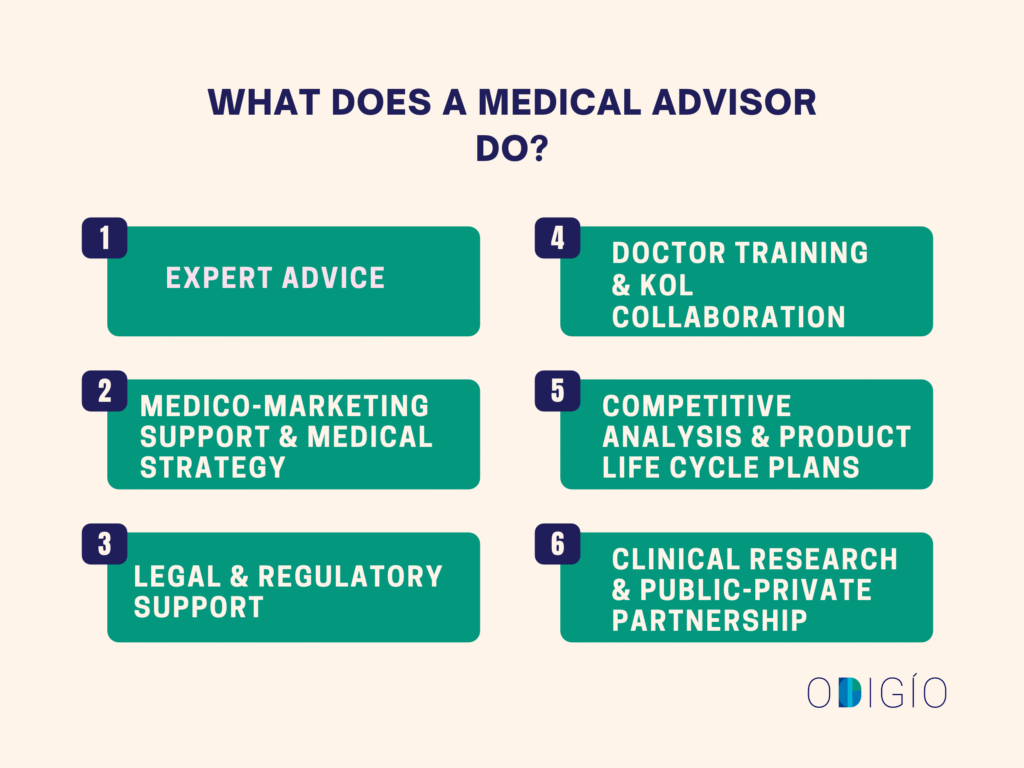
Although the exact responsibilities vary by company, therapeutic area, and seniority. You can demonstrate many of these skills even without industry experience, and a focused portfolio is one way to do that.
Is a Medical Advisor Career Right for You?
You might enjoy being a Medical Advisor if you:
- Love science: You enjoy research, clinical evidence, and staying updated on treatments.
- Enjoy collaboration: You like working with doctors and teams across marketing, research, and regulatory affairs.
- Think strategically: You’re interested in how medical knowledge shapes product decisions and healthcare initiatives.
- Prefer corporate work: You enjoy structured, desk-based work, scientific communication, and planning. Some roles also involve meetings and travel.
- Love travelling: If you enjoy attending conferences, and exploring new places, roles involving field visits may appeal to you.
Medical Advisor roles are generally more office-based than Medical Science Liaison roles, which often involve frequent field visits. However, responsibilities vary by company.
If this sounds like you, the next step is understanding how to build a portfolio that showcases your skills.
How to Build Your Portfolio With No Experience?
You can build your portfolio from scratch without waiting for a job or depending on someone else for projects. To get started, try the following exercise
To begin with, pick one medicine you already know, for example, a commonly used medicine for diabetes, hypertension, or another disease you studied during BDS, then create a 5–7 slide presentation.
Once you’ve completed the presentation, add it to your portfolio as a ‘Drug Profile & Evidence Review.’ This way, you can demonstrate the following skills:
- Medical research
- Understanding clinical evidence
- Scientific communication
- Presentation skills
This exercise can demonstrate your medical research, evidence evaluation, scientific communication, and presentation skills.
Although it doesn’t replace industry experience, it gives employers an understanding of your skills. If you want to understand the role better, we have curated a roadmap that includes free courses.
Become a Regional Medical Advisor
Start here
Need Guidance With Your Non-Clinical Career Transition?
Dr. Anahita has guided clients through these very steps. Watch one of our clients share her experience working with Odigio Careers.
Regional Medical Advisor Daily Routine
A regional medical advisor’s day-to-day work includes a mix of office-based work and travel.
Depending on the company and role, you may:
- Travel to meet doctors and KOLs
- Attend conferences and scientific meetings
- Participate in advisory boards
- Visit hospitals or research centers
- Conduct medical training or presentations
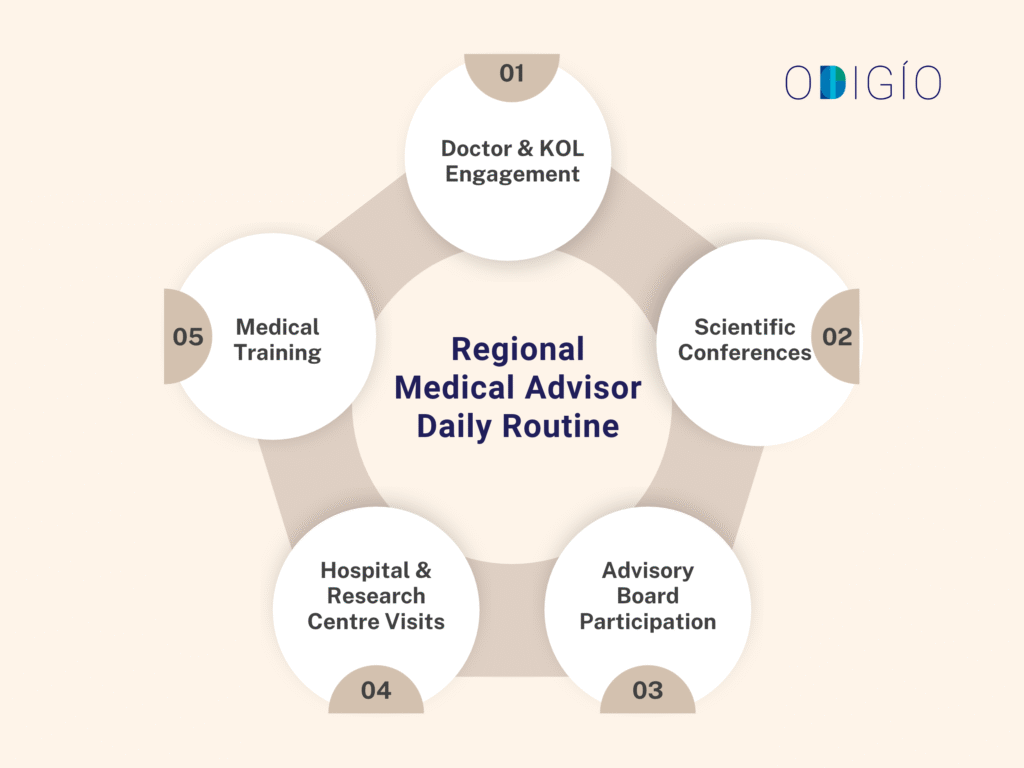
Medical advisor roles are generally more office-based, whereas MSL and regional medical advisor roles can involve more frequent travel across their assigned territory.
Difference Between a Medical Advisor, a Medical Science Liaison, and Medical Affairs
All these roles are interconnected to each other. The table below gives a clear overview of each role.
Once you know which role you’re targeting, the next question is whether you need an additional degree or certification to get there.
- Primary Role: In-house medical expert providing scientific and strategic guidance to pharma/healthcare companies.
- Work Location: Office-based (HQ or regional office)
- Core Responsibilities: Support medical strategy, scientific content, and product-related decisions.
- Interaction With: Internal teams (marketing, sales, regulatory, R&D)
- Typical Background: MBBS, BDS, BPharm, MPH, MSc, PhD + experience in pharma or medical content.
- Skills Required: Scientific communication, compliance, cross-functional collaboration
- Growth Path: Senior Medical Advisor → Medical Affairs Manager → Medical Director
- Primary Role: Build scientific relationships with doctors, researchers, and KOLs.
- Work Location: Field-based (frequent travel to hospitals, conferences, etc.)
- Core Responsibilities: Present clinical data, exchange scientific insights, and support medical education.
- Interaction With: External stakeholders (doctors, researchers, KOLs)
- Typical Background: Similar to Medical Advisor; often MBBS/PhD/MSc/BDS/BPharm + strong communication
- Skills Required: Scientific communication, compliance, cross-functional collaboration
- Growth Path: Senior MSL → Regional MSL Lead → Director of Field Medical Affairs.
- Primary Role: Umbrella department responsible for medical accuracy, strategy, and ethical compliance
- Work Location: Both office and field-based, depending on the role
- Core Responsibilities: Manage medical strategy, approve scientific content, oversee compliance and communication across teams
- Interaction With: Cross-functional teams + both internal and external experts
- Skills Required: Strategic thinking, communication, and regulatory awareness
- Growth Path: Medical Director → Therapeutic Area Head → Global Medical Affairs Lead.
Do You Need Any Certifications to Become a Medical Advisor?
There is no single mandatory certification that will make you eligible to become a medical advisor. Instead your healthcare-related degree is enough for you to get into the role.
Therefore, think of certifications as a way to fill a skill gap, not as a ticket to becoming a medical advisor. With this in mind, you could consider doing the following FREE courses:
- Clinical research fundamentals, GCP
- Medical writing and scientific communication
- Clinical research and clinical data interpretation
- Regulatory affairs fundamentals
Note: At Odigio, we do not recommend doing any paid courses.
Certifications can fill specific skill gaps. However, they are only one part of your profile. In addition, employers also look at the skills you can demonstrate.
Let’s understand some of the essential technical and soft skills in the next section that you should develop and demonstrate over time.
What Are Top Skills Required for a Medical Advisor With a BDS Degree?
The key skills include medical knowledge, clinical research, evidence evaluation, communication, collaboration, presentation, and critical thinking.
These skills fall into two categories: technical skills and soft skills. Next, let’s explore how you can use your existing abilities and identify the skills you may need to develop.
Technical Skills Required for Medical Advisor Role in India
| Technical Skills | What you need to know/do |
|---|---|
| Medical & Scientific Knowledge | Understand diseases, treatments, medicines, and clinical data to discuss it with doctors and KOLs. |
| Clinical Research | Understand the basics of clinical trials, study protocols, patient recruitment, and how clinical studies are conducted. |
| Research & Evidence Evaluation | Learn to find reliable medical information, read research papers, understand clinical data, and evaluate whether the evidence supports a particular conclusion. |
| Patient Safety Protocol | Understand how medicine-related safety concerns are monitored and reported. |
| Regulatory Knowledge | Know the basics of GCP, ICH, and relevant regulatory guidelines involved in product registration, approvals, clinical research, and medical activities |
| Medical Writing & Scientific Communication | You should be able to prepare or contribute to scientific presentations, publications, reports, and responses to medical queries. |
| Product & Disease Knowledge | Understand the products you work with, the disease area they address, available treatments, and the latest developments in that field. |
Soft Skills Required for Medical Advisor Role
| Soft Skill | How it translates to the medical advisor role |
|---|---|
| Communication Skills | Clear scientific communication with HCPs & stakeholders |
| KOL Management | Building strong relationships with KOLs & HCPs |
| Analytical Thinking | Evaluating clinical evidence & medical insights |
| Collaboration | Effective cross-functional teamwork |
| Presentation Skills | Delivering impactful scientific presentations |
| Project Management | Planning & executing medical initiatives |
| Problem-Solving | Addressing medical & operational challenges |
Where Can You Find Medical Advisor Jobs in India?
When searching for opportunities, you can explore several platforms. For example, you can use
- LinkedIn & Indeed: Search for the job title along with your location, for example, “Regional Medical Advisor India” or “Medical Science Liasion Mumbai.”
- Company career pages: Check the careers pages of pharmaceutical, medical device, and healthcare companies directly.
What is the Average Salary of a Medical Advisor?
The salary of a regional medical advisor in India varies depending on the employer, work sector, candidate’s classification, and experience.
Therefore, depending upon these factors, the starting salary range varies between Rs. 9 Lakhs and 20 Lakhs.
These figures reflect Odigio alumni salaries and should be treated as a broad reference, not a promise of what a career switcher or entry-level applicant will earn. Some employers report lower or higher salaries.
Start Your RMA Journey
Let’s get started
Different Types of Medical Advisor Roles Across Industries
Here’s a breakdown of the career scope for different medical and dental clinical advisors:
What are Some of the Personal Skills Required for the Role?
According to our subject experts, the skills required to land a role as a medical advisor in the healthcare industry are:
- Networking
- Strong communication skills
- Ability to collaborate across teams
- Analytical thinking to interpret clinical data
- Strategic thinking to organise medical activities

What Kind of Companies Hire Medical Advisors?
Primarily, pharmaceutical companies hire medical advisors because they have a dedicated team and require extensive expert clinical advice.
Many product manufacturing, biotech, and AI-based health-tech companies also require healthcare professionals as advisors.
Conclusion
Becoming a medical advisor after BDS is possible, but there isn’t one fixed route.
For example, some BDS graduates may enter medical affairs through RMA or MSL roles, while others may first gain relevant experience in medical affairs, medical writing, or clinical research.
Your BDS gives you the medical foundation. However, you also need to show employers how your clinical knowledge, communication, research, presentation, and collaboration skills translate into the role.
To begin, understand which roles you’re eligible for. Next, identify your skill gaps and build evidence that demonstrates your ability to do the work.
If you’re someone who wants to make a larger impact on healthcare while still staying connected to the science, this might just be your ideal path.
Book a call with our field expert and start with the transition.
Talk to a Career Expert