
Content Writing After BDS in India
Edited by: Dr. Aarushi Trehan, Reviewed by: Dr. Anahita Deo
If you’re a BDS graduate unsure about your future beyond clinics, you’re not alone. Many dentists in India are now exploring non-clinical careers like content writing, but most don’t know where or how to start.
Content writing after BDS is one of the accessible and flexible career options, allowing you to use your medical knowledge in digital, pharma, and healthcare industries.
In this guide, you’ll learn how to start, the required skills, salary, and real career opportunities.
Understanding Content Writing
What is Content Writing After BDS?
Content writing is the process of developing authentic content in various forms, like blogs, scripts, medical articles, and educational materials, for both digital and physical platforms.
Instead of treating patients, you:
- Simplify complex information
- Write for websites, pharma companies, or health platforms
- Educate patients and professionals through content
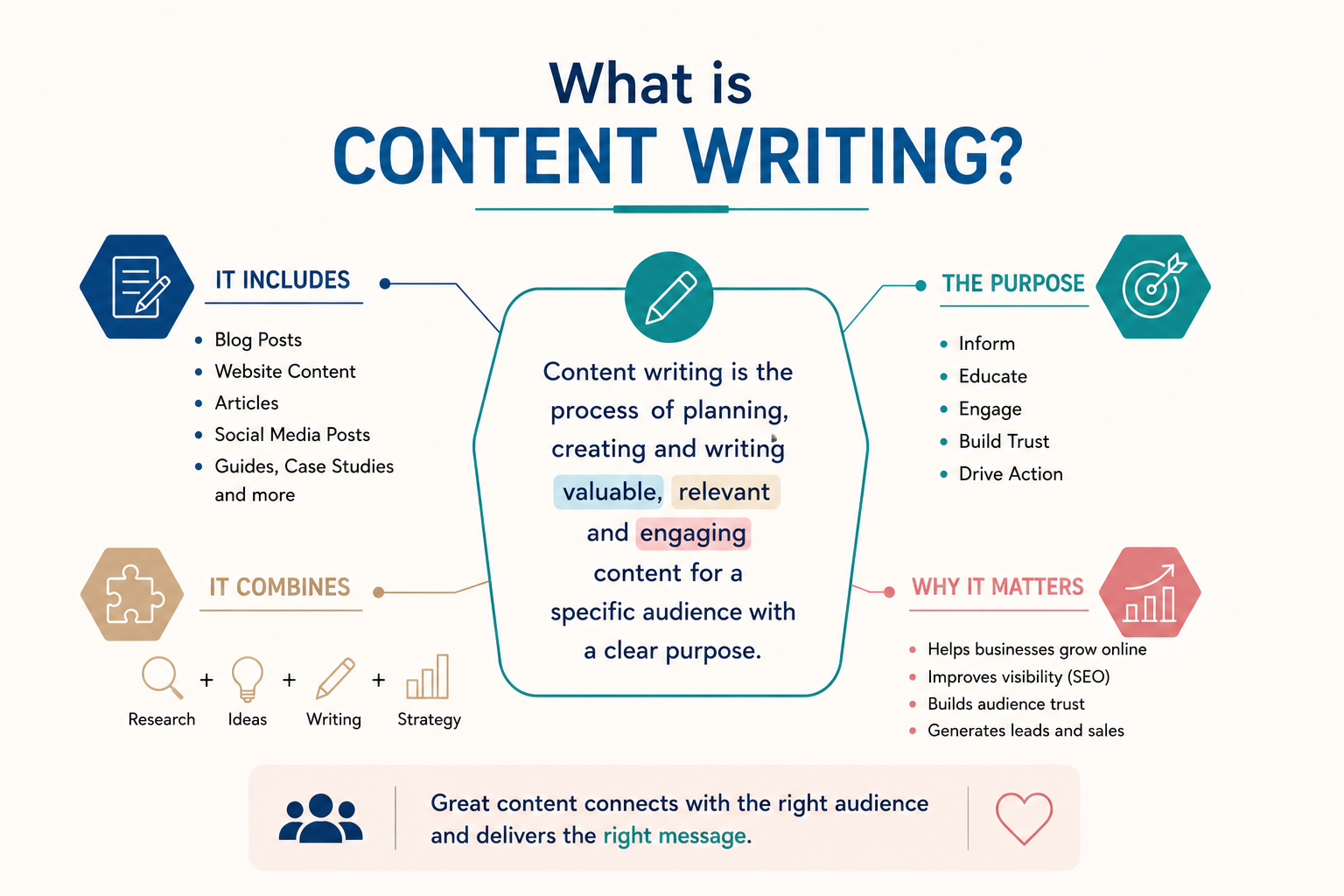
The goal is to benefit the target audience for marketing, entertainment, or educational purposes. But can a BDS graduate transition into this role? Let’s understand it below.
Can BDS Graduates Become Content Writers?
Yes, a BDS graduate can become a content writer because, as a dental graduate, you already have an advantage over non-medical writers.
You understand:
- Medical terminology
- Disease conditions
- Patient psychology
- Clinical accuracy
This makes you highly valuable for:
- Healthcare companies
- Pharma brands
- Medical education platforms
Now that you understand the basics, let’s explore the different types of content writing you can pursue after BDS.
Ready to Start?
Talk to us
Types of Content Writing for Healthcare Professionals
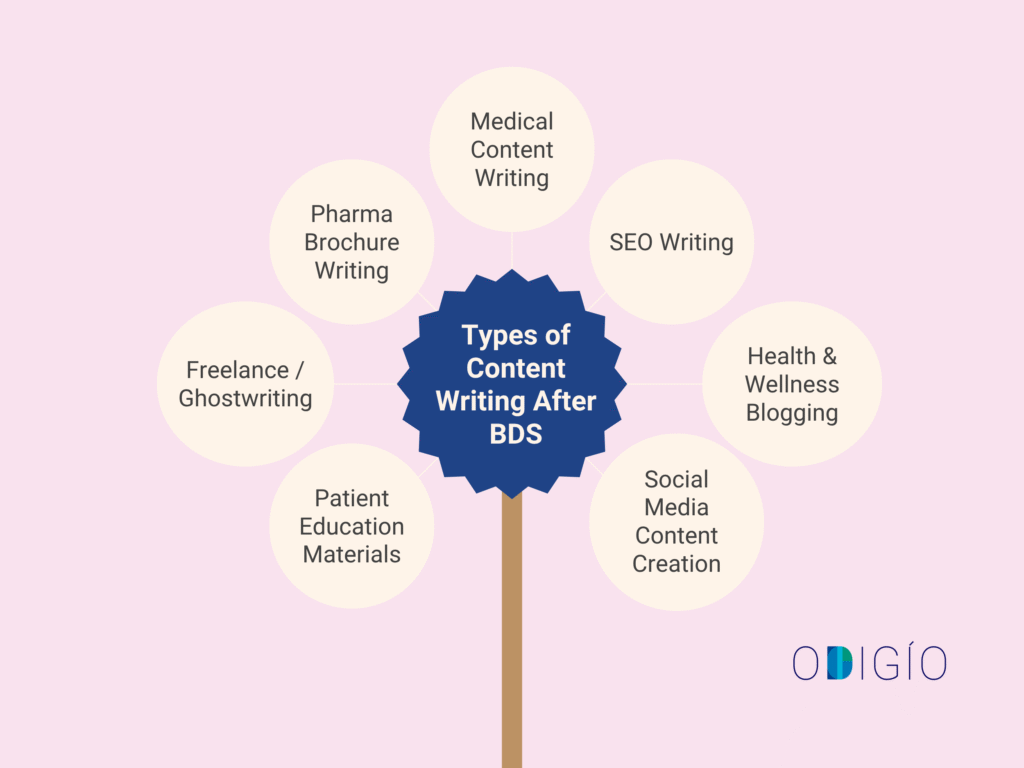
You can explore multiple roles depending on your interest:
Digital & SEO Content
- Medical Content Writing – Blogs, healthcare websites
- SEO Writing – Google-ranking articles
- Health & Wellness Blogging – Lifestyle, preventive healthcare content
Creative & Communication-Based Content
- Social Media Content Creation – Health awareness posts, campaigns
- Patient Education Materials – Simplified medical information for patients
- Freelance / Ghostwriting – Writing for clients without public credit
- Pharma Brochure Writing– Requires evidence-based content that balances marketing with regulatory compliance.
If you want to get into technical and research-based writing, you can explore medical writing after BDS.
Source: SideHustlesIndia(1)
Let’s address a common confusion between two writing formats, copywriting and content writing, below.
How is Content Writing Different From Copywriting?
Here are some of the basic differences between content writing and copywriting.
| Aspect | Content Writing | Copy Writing |
|---|---|---|
| Goal | Educate & build trust | Persuade & convert |
| Approach | Informative, research-based | Persuasive, emotion-driven |
| Writing style | Detailed, structured, SEO-focused | Short, punchy, benefit-focused |
| Typical formats | Blogs, articles, SEO pages | Ads, landing pages, sales emails |
| CTA | Soft (read more, learn) | Strong (buy, sign up) |
While the roles may vary, the core skills required to succeed in content writing remain consistent.
Transferable Skills: Clinic to Content Writing
Many BDS graduates think transitioning to a non-clinical career means getting another degree or doing a paid course. But that’s not the reality.
Here are some of the skills that can translate into a content writing role.
- Attention to Detail → Editing
- Recording case histories and analysing radiographs translates into accurate proofreading and fact-checking in content.
- Patient Communication → Simplified Writing
- Explaining procedures to patients translates into breaking down complex medical topics for readers.
- Medical Knowledge → Credible Content
- Your understanding of dental subjects applies to writing accurate and reliable healthcare content.
- Research Skills → Evidence-Based Writing
- Referring to textbooks and journals carries over into creating content backed by credible sources.
- Diagnosis → Research Skills
- This skill helps you research topics deeply and bridge the gap
- Time Management → Meeting Deadlines
- Managing clinics and exams applies to delivering content on time without compromising quality.
- Case Understanding → Content Structuring
- Helps in creating logical, structured articles
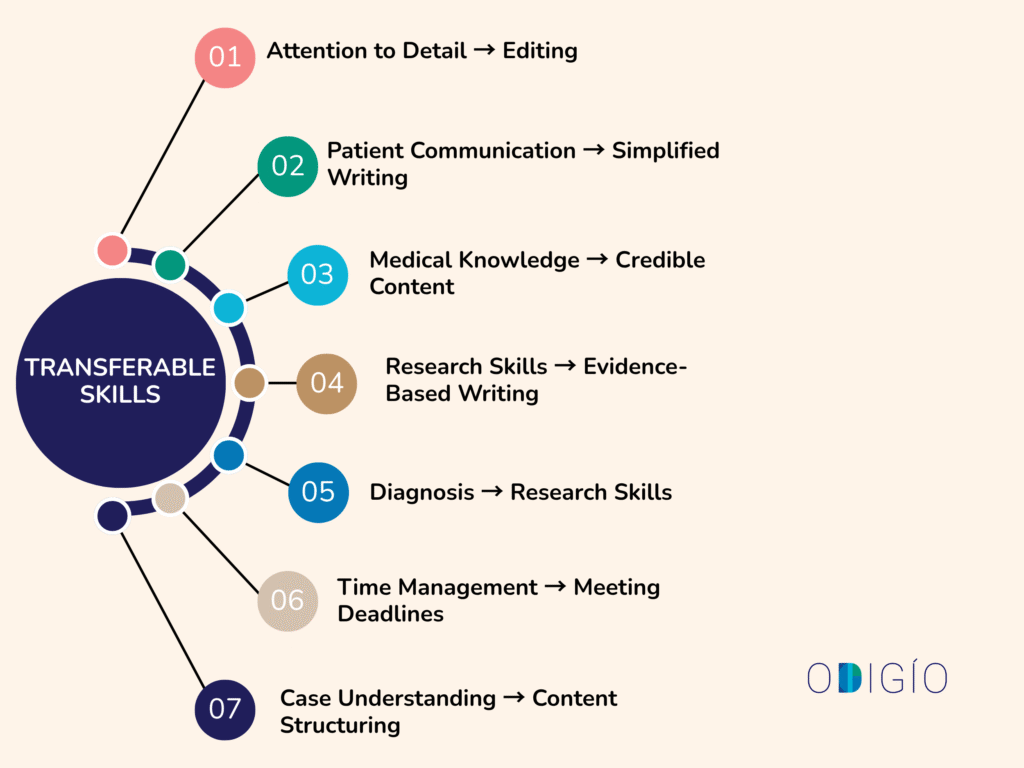
Your clinical background becomes your biggest strength. Let’s see what some of the technical skills that you will learn at the job.
Ready to switch careers?
Explore Here
Technical Skills Required for Content Writing After BDS
To build a successful career in content writing after BDS, you need to develop specific technical skills that go beyond basic writing.
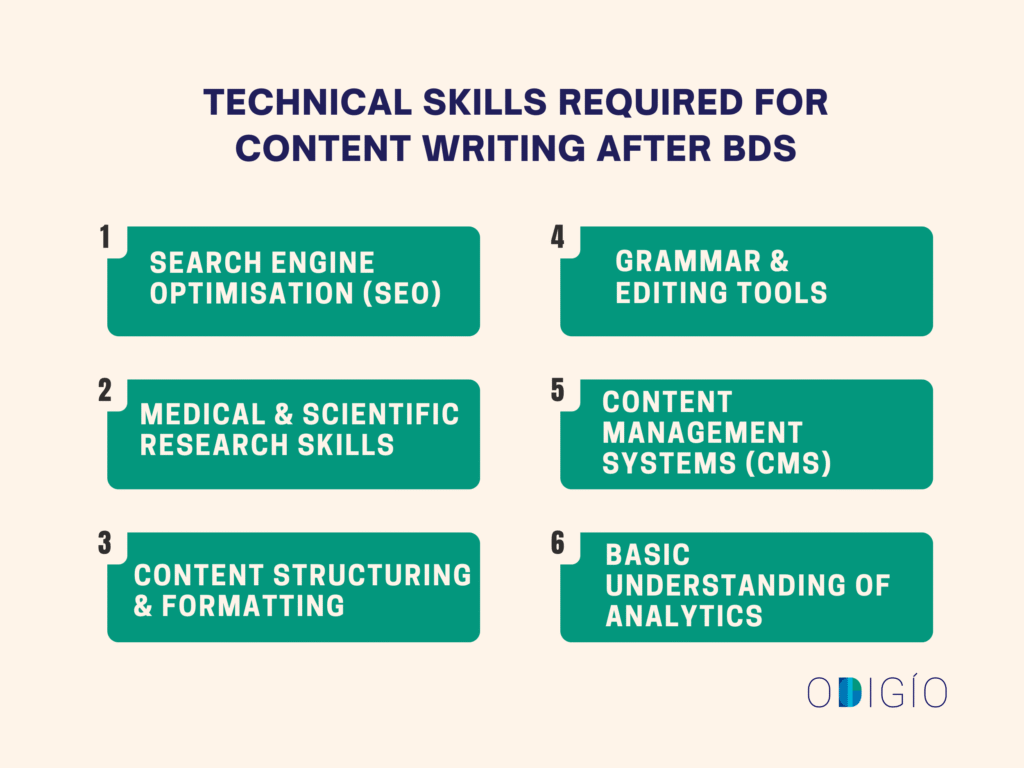
Disclaimer: Odigío Careers only recommends availing free courses to learn and grow.
While these technical skills can be learned over time, your clinical background already gives you an advantage in understanding medical content, making the learning curve much faster.
Content Writing After BDS
Start Here
How to Start a Career in Content Writing After BDS?
You can follow these basic steps to start your career as a content writer.
Roles Available in Content Writing in India
Here are some of the common job roles that you can pursue:
- Writes and edits research articles, regulatory documents, & medical education material by adhering to the industry standards (ICMR, AMA, or FDA guidelines).
- Extracts data from medical databases like PubMed, Scopus, Web of Science, etc., to simplify complex medical data into understandable and precise content.
- Works with cross-functional teams to create research documents, including informed consent forms, clinical study forms, and pharmacovigilance reports.
- Writes engaging and carefully researched information on health, nutrition, and wellness to educate and motivate readers, providing better blog writing services in India.
- Combines scientific knowledge with storytelling to create content that is more relatable and user-friendly.
- Applies SEO strategies for better reach and blog visibility.
- Conducts keyword research and applies best SEO practices to maximise user interaction.
- Monitors website performance using tools like Google Analytics, Google Search Console, and SEMrush.
- Creates data-driven content plans, blogs, and social media marketing campaigns that align with the brand objectives, readers’ needs, and latest market trends to increase website engagement.
- Creates clear, persuasive content for drugs and healthcare products in line with industry guidelines, including GMP and ICH-GCP.
- Draft advertisements, materials, drug specifications, and instruction guides to simplify health information for the users.
Should you do a Certificate Course for Content Writing?
Taking a certificate course in content writing is a personal choice, but it’s not required to get started.
At Odigio, we generally recommend free learning resources over paid certificate programs, especially for beginners.
Content writing is a skill you build through practice, feedback, and rewriting, not certificates. No course can replace the process of writing regularly and improving with time.
That said, if you want structured learning, it’s better to focus on SEO fundamentals rather than generic “content writing” certificates.
SEO helps you understand why content is written a certain way and how it performs online, a skill clients value far more than course credentials.
Start with a free SEO certificate, apply what you learn by writing consistently, and build samples.
That combination matters more than any paid certificate.
If you’re curious about taking writing seriously after BDS, remember this: there isn’t a different course for every type of writing. SEO, content, and marketing writing share the same base skills.
To keep things simple, we’ve created a roadmap with free resources that brings these fundamentals together, showing you where to start and what to focus on.
Begin Your Writing Journey After BDS
Start today!
Odigio’s Tip: To learn more about writing and marketing, LinkedIn is the best platform today.
Follow relevant writers who actively share insights, breakdowns, and real experiences in content and SEO writing.
Importance of SEO in Content Writing after Dentistry in India
What is SEO and Why Does It Matter?
- SEO (Search Engine Optimisation) is an emerging digital marketing practice that increases the visibility of websites by improving ranking on search engines like Google, Yahoo, and Microsoft Bing.
- In content writing, SEO helps search engines locate and interpret content by using specific keywords and crafting high-quality content (e.g., incorporating headings and description tags).
SEO Optimisation Tools
Understand how different SEO Tools enhance a website’s visibility:
Source:semrush(2)
While the opportunities are growing, transitioning into this field does come with its own set of challenges.
Other Tools Used by Content Writers
Here are some of the tools commonly used while writing:
- Writing Tools & Plagiarism Checkers: Grammarly, Quillbot
- CMS Platforms: WordPress
While content writing offers flexibility and opportunities, transitioning into this field also comes with its own set of challenges.
Role of AI in Content Writing
AI is transforming the content writing industry by making the writing process faster, more efficient, and scalable.
However, it is not a replacement for human writers, especially in fields like healthcare, where accuracy and context are critical.
To better understand the role of AI in content writing, let’s look at what it can and cannot do.
| What AI Can Do | What AI Cannot Do |
|---|---|
| Generate ideas, outlines, and draft content quickly | Replace domain expertise, especially in healthcare |
| Improve grammar, readability, and sentence structure | Ensure complete accuracy in medical or scientific content |
| Assist with basic SEO (keywords, formatting, headings) | Understand context, nuance, or patient sensitivity fully |
| Help rephrase and simplify content | Take full responsibility for ethical and factual correctness |
| Speed up the writing and editing process | Create original insights or real-world experience-based content |
| Support research by summarising information | Verify sources or guarantee evidence-based accuracy |
AI is a co-creation tool, not a replacement. The quality of output depends on how well you guide it, making prompt writing an essential skill for content writers.
Challenges Faced in Transitioning to a Content Writing Career
Common Challenges
For a dentist, stepping into a content writing career is challenging because:
- Adapting to a new working atmosphere.
- Continuously upgrading skills to sync with the growing content strategies.
Overcoming Challenges
To overcome these challenges, one must:
- Network with industry professionals to obtain insights and advice.
- Seek mentorship for appropriate guidance throughout the learning process.
- Application of the acquired skills is necessary because writing improves with effort and time.
Conclusion
For healthcare professionals, content writing after BDS is not about leaving medicine behind; it’s about using your clinical knowledge in a different format.
Your training has already taught you accuracy, ethics, research, and how to explain complex information clearly. These are the exact skills healthcare writing demands.
You don’t need to relearn everything or start from zero.
By writing consistently, understanding basic SEO, and building a simple portfolio, you can explore content writing alongside your medical background at your own pace.
For many healthcare professionals, writing becomes a flexible, sustainable career option, whether as a full-time role, freelance work, or a parallel skill. The key is to start small, stay focused, and grow steadily.
Take the First Step
Book a Call
Content Writing After BDS: FAQ
References
- SideHustlesIndia: Different types of content writing as a side hustle
- Semrush: 6 Free Google SEO Tools to Boost Your Search Visibility