
Exploring Non Clinical Careers After BDS
Do you want to transition from a clinical to a non-clinical career after BDS and need a platform to get started? You’re in the right place.
This blog helps you navigate the transition with clarity, structure, and the right resources. But before that, let’s understand what we are getting into.
What are Non-Clinical Jobs?
Non-clinical jobs refer to roles within the healthcare industry that do not involve direct patient care, also known as corporate roles.
These positions enable BDS graduates to apply their medical knowledge in areas such as healthcare consulting, healthcare marketing, research, and medical technology (MedTech).
Non-clinical roles offer a refreshing change from the demanding environment of clinical practice, allowing you to work within healthcare while building transferable skills useful across various industries.
By exploring non-clinical options, BDS graduates can contribute to healthcare in innovative and impactful ways that can bring about large-scale changes to the Indian Healthcare system!
Exploring Corporate Opportunities
Now, let’s dive deeper into corporate opportunities. The corporate world offers a plethora of career paths for BDS graduates, where medical expertise is highly valued.
Roles in product development, pharmaceutical sales, and healthcare management allow graduates to be at the forefront of innovation and business strategies.
These positions not only offer competitive salaries but also provide a platform to influence and shape the future of healthcare on a larger scale.
Corporate roles can be immensely rewarding, offering a blend of professional growth and the chance to make a significant impact in the industry.
Confused About Your Career Path?
Talk to Our Consultant
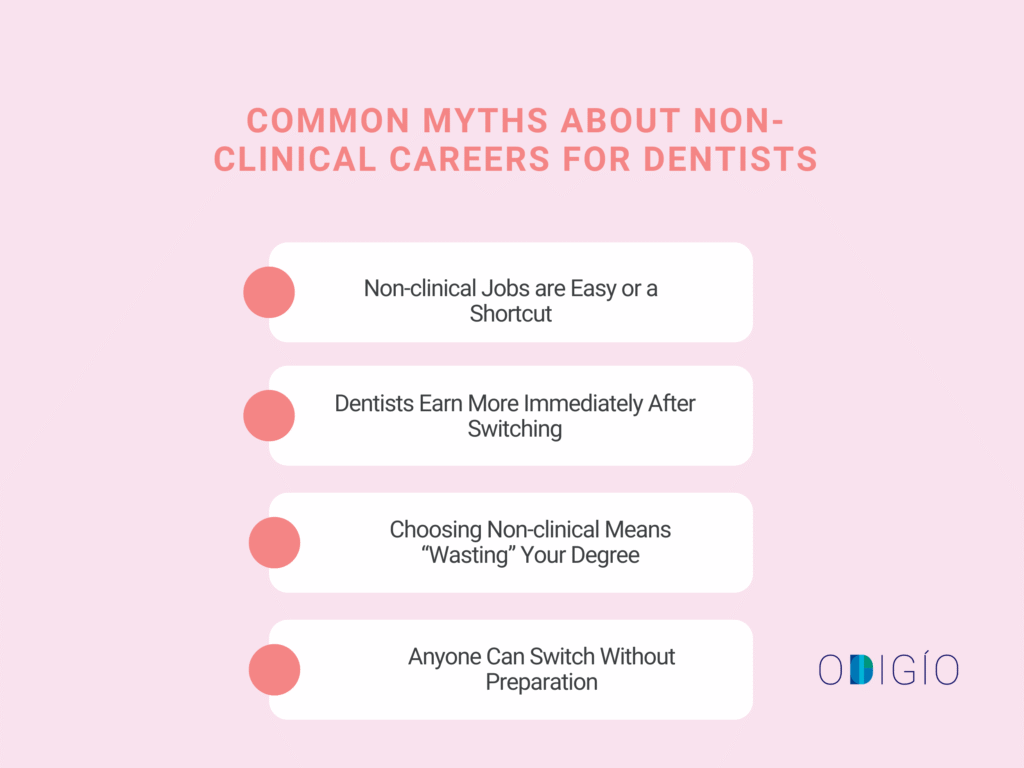
Common Myths About Non-Clinical Careers for Dentists
There are many myths associated with transitioning into roles that do not involve clinics. Some of the most common misconceptions are addressed below.
- Non-clinical Jobs are Easy or a Shortcut: No! Most roles require learning new skills and adapting to corporate expectations.
- Dentists Earn More Immediately After Switching: It is not about the money; it’s more about what you enjoy doing. If you pursue your passion, money follows.
- Choosing Non-clinical Means “Wasting” Your Degree: That’s not true, a dental degree is dynamic, and helps you make an impact even outside clinics.
- Anyone Can Switch Without Preparation: Nothing comes easy. Transitioning from a clinical to a non-clinical domain requires a strategic approach, upskilling, and effective positioning.
Is a Non-Clinical Career the Right Choice for Everyone?
Whether a non-clinical career is the right choice for you completely depends on your preferences.
However, one piece of advice is not to give up on clinics just because your friends are doing so. Here’s what you should look for before transitioning:
- Enjoy communication, planning, or analytical work
- Prefer structured work environments
- Are open to learning business or tech skills
- Want long-term scalability rather than immediate income
Dentists who strongly value hands-on procedures, clinical autonomy, or private practice ownership may still find clinical paths more fulfilling.
Understanding your personality, strengths, and risk tolerance is critical before making the shift.
Benefits of Non-Clinical Roles
Apart from this, BDS graduates can advance into roles such as healthcare consulting, pharmaceuticals, medical technology, and research, which can offer pathways to senior positions and specialised fields.
Let’s understand in detail what kind of roles you can get into as a dentist, beyond clinical dentistry.
Source: medicaleconomics(1)
Roles in Corporate for BDS graduates
Now that we’ve explored the professional and personal perks, let’s dive into the various roles you can apply for.
Medical Advisor
- A medical advisor is an experts who guide pharma/biotech companies.
- The profession addresses larger healthcare challenges by ensuring ethical, legal, and evidence-based development of safe and effective products.
Clinical Data Manager
- Clinical data management is the systematic process of collecting and validating clinical trial data.
- The goal is to produce high-quality data that is compliant & supports the evaluation of new healthcare advancements.
Clinical Research Associate
- A CRA is a healthcare professional who oversees the clinical trial process and ensures strict adherence to protocol.
Soft skills, including medical knowledge, patient handling experience, and an understanding of healthcare regulations, make you a strong fit for the above-mentioned roles.
Medical Writing
- Medical writing is employed to produce accurate, evidence-based healthcare content for clinical, regulatory, educational, and marketing purposes throughout the healthcare industry.
- Soft skills, such as communication, attention to detail, and critical thinking, make you a perfect fit for this role.
Social Media Manager
- Social media management enables health information to reach the audience through social platforms.
- It involves planning, creating, and managing content that builds awareness, trust, and engagement while maintaining accuracy and compliance.
- Your patient interaction helps you create content that is relatable, trustworthy, and sensitive to audience concerns.
Content Writing
- Content writing involves creating clear, engaging, and audience-focused material that educates, informs, and communicates value across digital platforms.
- Basic skills required: Strong communication, research ability, audience understanding, attention to detail, and basic SEO knowledge.
Product Management
- Product management in healthcare is the process of conceptualising, innovating, planning, developing, marketing, and launching products.
- As an HCP with clinical expertise, including problem-solving, decision-making, and cross-functional collaboration, you gain a competitive advantage in this field.
Healthcare Consultant
- Their role is to advise healthcare businesses on strategy to enhance efficiency, quality of care, and informed decision-making through the use of data, strategy, and clinical insight.
- HCPs with skills such as strong communication, empathy, critical thinking, adaptability, teamwork, and ethical judgment make the right fit.
Kickstart Your Career
Book a Call Today!
Now that you have an overview of the types of roles in a non-clinical career, let’s understand the skills required to excel in the chosen field.
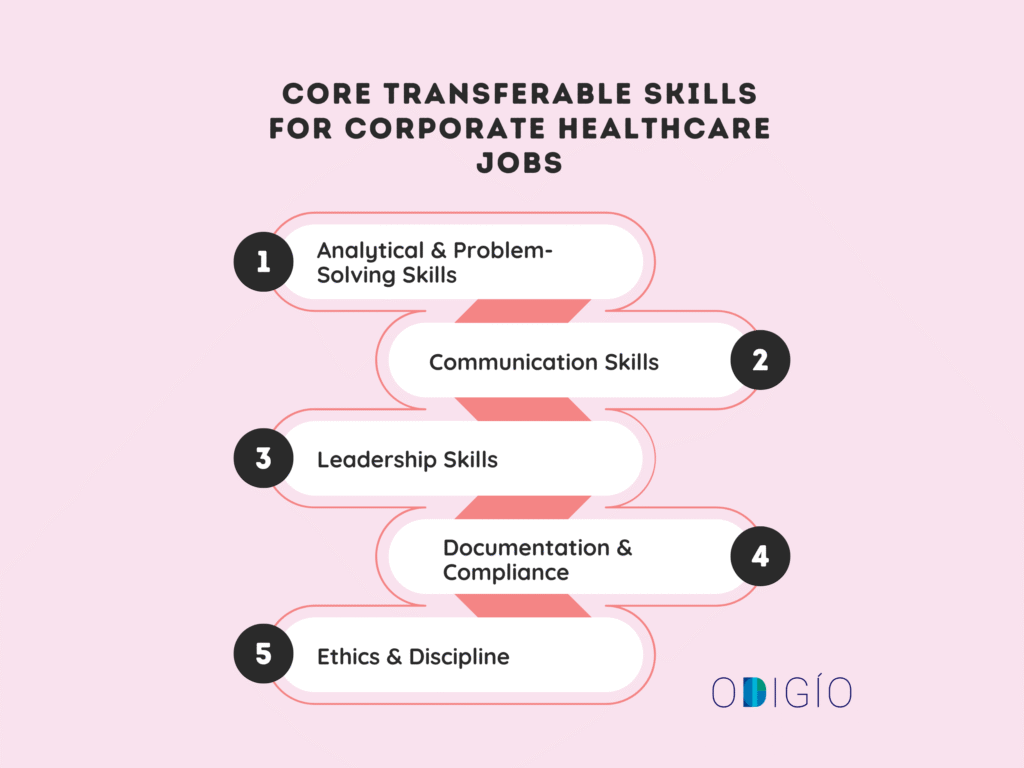
Transferable Skills for Corporate Healthcare Jobs
Many BDS graduates underestimate how transferable their existing skills are when transitioning into non-clinical roles.
As a dentist, you have already been trained with competencies that are highly relevant across corporate, consulting, research, and management roles.
Below are some of the transferable skills:
- Analytical & Problem-Solving Skills: Clinical case analysis translates directly into data interpretation, reporting, and structured decision-making roles.
- Communication Skills: Patient counselling develops strong client and stakeholder communication skills, which are applicable in various roles, including marketing, consulting, and management.
- Leadership Skills: Handling patients and coordinating teams during internships prepares you for project and team management roles.
- Documentation & Compliance: Clinical records and protocols align closely with compliance, regulatory, and quality assurance roles.
- Ethics & Discipline: Ethical clinical decisions and discipline support success in process-driven and governance-focused roles.
Many believe non-clinical careers require prior technical skills, but this isn’t true. Such skills are learned through internships and free courses, so a lack of them shouldn’t limit choices.
Once you’ve identified the right non-clinical role and assessed your existing skills, the next step is understanding how to make a smooth and strategic transition.
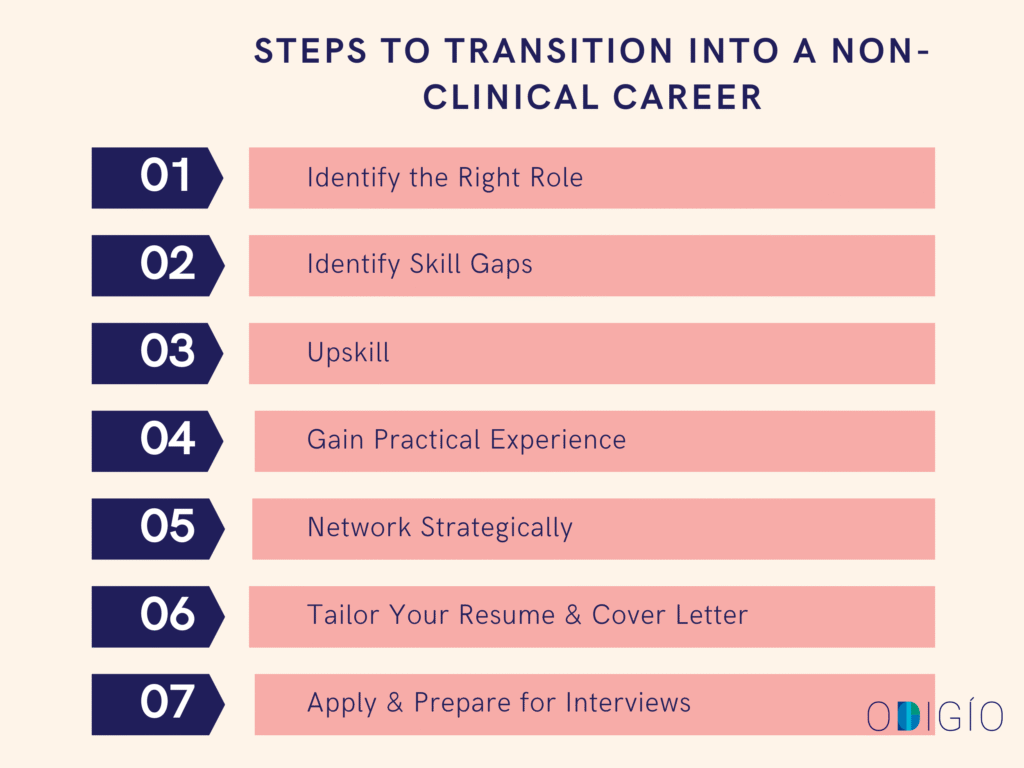
Steps to Transition into a Non-Clinical Career
- Step 1: Identify the right role, evaluate non-clinical career options that align with your interests, strengths, and long-term objectives.
- Step 2: Identify skill gaps by comparing your existing soft skills with the role requirements to pinpoint areas that require upskilling.
- Step 3: Upskill with free courses and certifications, and strengthen your profile with relevant skills in your target field, such as digital marketing, business analysis, or management.
- Step 4: Gain practical experience by building hands-on skills through internships, part-time roles, freelance projects, or live assignments.
- Step 5: Network strategically by connecting with industry professionals through LinkedIn, conferences, and professional organisations to explore opportunities and gain mentorship.
- Step 6: Tailor your resume & cover letter, highlight transferable skills and relevant experience, and customise applications to match each job description.
- Step 7: Apply & prepare for interviews, apply with clarity and prepare for role-specific interviews to position yourself as a strong candidate.
Source: linkedin(2)
Salary Growth and Career Progression in Non-Clinical Roles
The career growth is variable and depends on how an individual develops role-specific skills over time.
Typically:
- Entry-level roles focus on learning and execution
- Mid-level roles involve strategy, ownership, and leadership
- Senior roles offer influence, stability, and decision-making power
While starting salaries may not exceed clinical earnings immediately, non-clinical careers often provide:
- Faster role progression
- Opportunities across industries and geographies
Long-term growth depends more on skill depth than years of experience alone.
Job Search Strategies for Non-Clinical Careers in Healthcare
Now that we’ve taken steps for transitioning into non-clinical roles, let’s explore some practical job search strategies.
Finding the right job can be a game-changer. Here are some top spots to check out:
- LinkedIn: Network with the top performers in the field you are interested in and discover job postings.(3)
- Indeed: A one-stop job search engine which will provide you with a plethora of options
- Internshala: Great for finding internships to boost your experience
Resume and Cover Letter
- Customise for each job
- Highlight transferable skills and experiences
- Keep it clear and quantify achievements
Interview Prep and Techniques
- Research the company
- Practice common questions
- Read about AI and its incorporation in the role that you’re applying for
Source: forbes(4)
Conclusion
Exploring non-clinical careers is not about rejecting dentistry; it’s about choosing a career path that aligns with your strengths, lifestyle expectations, and long-term goals.
Dentistry offers multiple paths, and success takes different forms for everyone. The key is clarity, patience, and informed decision-making.
With the right preparation, dentists can build impactful, fulfilling careers beyond the clinic while still honouring their medical foundation.
Don’t Wait!